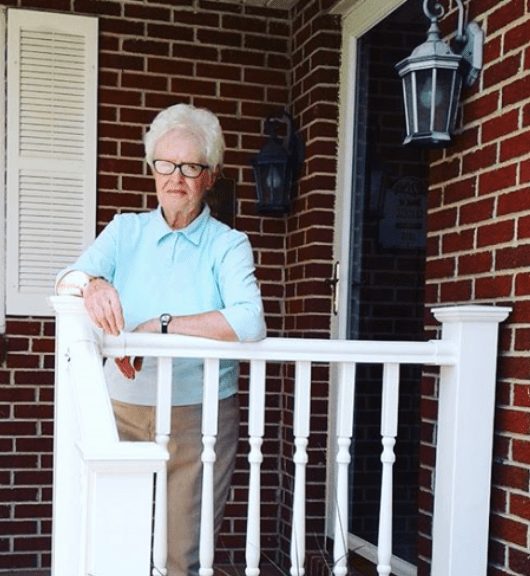
I had less than 48 hours to prepare for her passing, though I suppose in truth I had 45 years. When you have a grandmother so long, at some point you subconsciously start preparing. After all, who gets to keep such preciousness for so many years? Who gets to say “my 93-year-old grandmother” and have it mean a woman who still mowed her own four acres, who lived alone by choice and preferred it, who colored every night from 6:30-8:30 after a dinner of—often—a peanut butter sandwich and a glass of wine from the vineyard down the road?
I saw her 34 days before for an early celebration of her 93rd birthday. We talked and told stories; she shared a laugh with my husband in a photo I am so thankful to have captured. I hugged her more times than I can count. When we spoke on the phone for her birthday ten days later, she told me of her adventure climbing Coronado Heights that day. She said the view was great, but the stairs seemed farther apart than they’d been thirty years ago, and then she laughed in the way that I knew would be accompanied by a slight shake of her giggly shoulders.
Her illness was quick. Small fits of hope scattered across twenty-four hours, but a major surgery, the fact that she was likely not well for days before she told anyone—a habit she had all my life—led to the truth. Those who loved her knew the light was going out.
My grandmother Kathleen Joy, who I called Nanny, was born in 1928 to the children of Swedish immigrants. She lived seven years of happiness before the first tragedy struck. Her father, the giant of her childhood, had a burst appendix in 1935 and quickly died from lack of penicillin. That loss led to another, her dog, which her mother said couldn’t be moved into Salina where they were going to live. Nanny lost two deep wells of love so close together that I’m not sure she ever let herself fully love again. She married twice, divorced once, had six children, lost one, lost a sister and her mother and her husband. She had 93 years of pain and heartbreak that she didn’t talk about much, but I imagine never truly left her.
At her house, I played pool in the walkout basement, watched satellite television, spun old 45s on the downstairs hi-fi, and read every single book I wasn’t supposed to. Harlequins. Danielle Steele. Jackie Collins—you name it. If Nanny read it, I did too. Reading Nanny’s books meant getting as far as I could when I was at the house, memorizing the page number where I left off, and sneaking back to the book to continue reading the next day. I don’t know how much I understood in those stories of lustful wives and philandering husbands, but I couldn’t stop reading.
Her house was also filled with dress-up clothes. I could be a fairy princess in my mom’s teal prom dress with the empire waist, or a nightclub singer in a gold lame number Nanny wore when she was honored as the president of Midway Regional Council of Parents Without Partners, Inc. in 1974. The thought of her in that dress, a slit up the side and shimmer for days, was enough to set me giggling as a kid. Now, I am just one year younger than she was when that celebration occurred, and I am breathless at the thought of her stepping out, gold and glittering, in a room where all eyes were on her.
That doesn’t gel with the woman I knew. Nanny didn’t like to be the center of attention. In fact, had her mother not pushed her to marry, I don’t know that she would have. I certainly doubt she would have had children. The fact of my existence is a testament to her Swedish mother’s insistence and Nanny’s role as a dutiful daughter. I never begrudged her the life I think she would have preferred—solo, a working girl who filled her time with books and travel. I’m thankful she didn’t get what (I think) she wanted; I’m happy to exist. But when my grandfather died and she was alone in that big house at 89, I suspect she finally had peace. No one to attend to. No one to please. Just acres of grass to mow and time to breathe into her own beautiful silence.
The house I knew as hers was built in 1975; I was born one year later. Every year of my life has memories of that red brick box atop a hill surrounded by Kansas sky. Every year of my life is filled with laughter and holidays and weekends and summers and birthdays and just because visits. Every year of my life, until now.
At work, above my desk, I have a picture from my college graduation. I am 24, embarrassed to have taken seven years to complete a task most accomplish in four, clueless about what to do next. My great-grandmother is in the foreground, her eyes off to the right, ready to walk to someone just out of the frame. My grandfather is behind me, the top of his head and shirtsleeve visible behind me. Nanny is the center of the photo, her eyes clear and bright looking into the camera, my arm around her, grateful for the solid fact of her. This morning, I realized everyone in the photo, except me, is gone. Losing her is a removal of all the little games I could play that put mortality out of view. As long as she was with us, I could be someone’s granddaughter, the little girl who loved her Nanny’s books and dress-up clothes who didn’t have to think about her own eventual and certain end.
I can’t play those games anymore.
In the first few days after her passing, I choked back sobs whenever I left my classroom. Returning to work only made sense; it’s what Nanny would have done. In all my life I never knew her to be sick with so much as a cold nor did I ever know a tragedy to slowed her down. That is not to say she was cold or heartless. I felt and knew her love every single day. But she was 100% Swedish. Wallowing wasn’t in her DNA.
Because I just kept going, I saw the most stunning fall in recent memory burning out its brilliance on my drive to and from work in the few days just after she died. Trees I have never seen turn brought out their best dresses, flames of gold glimmering in the trees, maples blazing a red you can see nowhere else but a Kansas autumn. Wind and weather have taken fall from us the last few years, but this week, it returned in a riot of color to send off the woman who loved to work in her yard and who taught me, when I unexpectedly loss my sweet dog in 2020, that growing things could be a good way to heal.
Because I just kept going, I read the end of a novel by a writer I love in the three days after Nanny died. The book includes a beautiful death in which a character sees their time is ending and embraces it as a chance to see loved ones long gone, a chance to return to the earth, a chance to begin again.
At my age, my Nanny was a working divorcee in a small town trying to provide for her family and help other single parents find community. She had no grandchildren yet, her children were unmarried; she didn’t know what was to come. Within two years she was married to a good man in a brick house atop a hill. She had a son-in-law and the first of what would be five grandchildren. She called that first, her only granddaughter, her “rose among thorns.”
 Shannon Carriger
this is flippin wonderful!
LikeLiked by 1 person
Thank you, Carol!
LikeLike