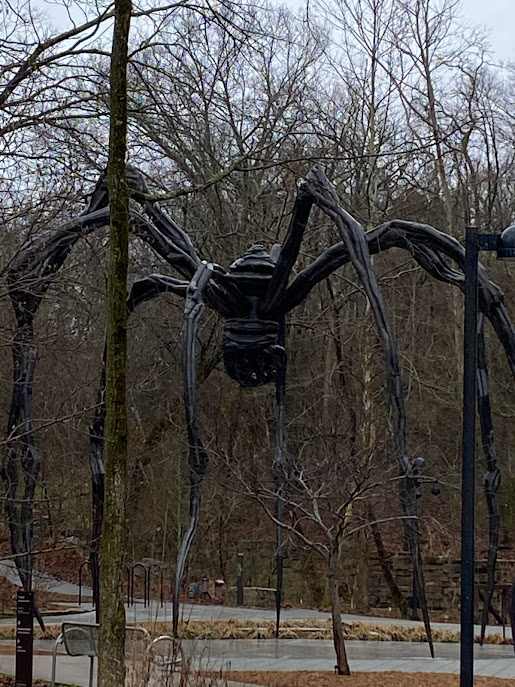
This thirty foot sculpture titled Maman (Mother of Spiders) by Louise Bourgeois once hovered over the entrance to Crystal Bridges, a museum in Arkansas. It was an ominous welcome to a place filled with light and art and brilliant expressions of humanity. Gorgeous and menacing, tall and terrible, symbolizing protection and venom, it has recently been relocated to the nature trail, and it always reminds me of high school.
My family moved when I was in eighth grade; I finished that year at my large Salina middle school and lamented the start of high school in Lindsborg where my graduating class would have only 42 students. It was a culture shock. Had we stayed in Salina, I could have certainly become a ghost in a 6A high school, circling the building with my theatre and choir kind, avoiding the worst tropes of high school. But I moved to a school where no one was invisible because there were simply too few of us to allow for much hiding. We all knew who had been drunk, smoked cigarettes, tried marijuana, and had sex without having to think too hard about it. Everyone just knew. It was idyllic and impossible in equal measure in that there were incredibly astute teachers who saw us and shaped us–hey Mrs. Wentz and Mrs. Texley–but making even small social mistakes were writ large.
Once, after kissing a senior boy after homecoming my freshman year, I came back to school on Monday and learned–according to the rumor mill that he helped gin up–I had actually had sex with him. Y’all. This did not happen. I was livid and horrified and just socially unaware enough to call him out about it during lunch by pulling him outside into a small courtyard space at the entrance of the high school where I yelled at him and told him he was going to tell every person he’d let believe the awful rumor that he had lied and under no circumstances had I or would I EVER have sex with him. I was 14, and he told me I should “think about my reputation.” I assured him that was exactly what I was doing.
As a high school teacher now, I see that my students can’t escape the things said about them. They can’t confront their tormentors in some quaintly anecdotal fashion because the tormentors are everywhere and anonymous and legion. They are ever-present in the halls, on social media, and in the rooms where school board meetings are held. The horror of high school grows.
In the last three months, since school began in my district, I have watched adults systematically seek to limit what children read, to shame, dismiss, and target students in the LGBTQIA+ community, and to degrade and devalue the profession I’ve devoted myself to for the last fifteen years. I am not a fan of the horror genre; I don’t read it or watch it, but folks, it seems of late, I am living in it.
In 2016, Slate contributor and screenwriter Ken Miyamoto developed a list of the Hallmarks of a Great Horror or Psychological Thriller. I expected it to be exhaustive, but it isn’t: just four things make the cut.
The Unknown: Miyamoto notes what we don’t know or can’t see is often more terrifying than the known entities surrounding us. High school students are navigating the unknown each and every day. They learn new concepts, meet new people, and wake up not knowing if today is the day there will be a Lockdown at school that turns ugly. We had one recently in my building; it was a false alarm, but we didn’t know it at the time. I sat in a silent room with 25 students, afraid to say anything because I didn’t know anything. The horror of that moment was palpable. When we got the all clear, several cried. I managed not to, but I’m still not sure how.
The second hallmark of a great horror movie is imagery–the kind that haunts us, the sort of things you can’t unsee. For those of you who watched the Netflix series Mindhunter, you likely have a number of these references. I got sucked into that one for the psychological profiling, but I wish I’d abandoned it before the last scene of the last episode of season one. If you’ve seen it, you know that imagery won’t leave you.
For the people outside of a school, what happens in those halls is unknown. I assure you that having once been a high school student doesn’t at all make you an expert on what is happening now. Even five years ago the experience was different, so the tormentors in power are quick to use the unknown landscape of American high schools as the backdrop for their imagery of fear. These bullies paint vivid pictures of out of control teachers indoctrinating students into liberal-pinko-commie-CRT loving-anti-faith animals who will destroy this country, by God, if they don’t put a boot to teachers’ necks and how. They vilify public education with the kind of imagery that even Edgar Allan Poe would have deemed a bit too far, and it works because the next great horror hallmark is, of course, fear.
What do people fear most? Losing a loved one? Dying young? Never having made a contribution to the world? While those are all high on my own list, they’re fairly individual, and many of use share them; all three make it on to Top 10 Fears lists every year, but the collective fear is the one that applies most to high schools. Collectively, the population of bullies outside of a high school fears being replaced by the population within it. The adult outsiders want to desperately cling to their own sense of power and relevance while forcing younger people who don’t look like, think like, or act like them to conform to some antiquated sense of “appropriateness.”
What a monumental waste of time.
All of us will be replaced one day. It is the inevitability of human existence: some day, we’re out of here. To spend what Mary Oliver deems your “one wild and precious life” trying to control other people has to be the saddest and most dangerous thing I’ve ever heard, especially when its coupled with an unerring, uninformed, and irrational righteousness.
Miyamoto says the final component of a great horror movie is the particular world in which the story unfolds. A high school, with its closed doors and private interactions in vestibules and down corridors, has a hundred possible worst case scenarios waiting around every corner. For high school students, they never know when a teacher might say something hurtful–because just as there are dirtbag pediatricians and politicians and plumbers, there are also dirtbag teachers–or when a classmate might have a meltdown. They are living in a world that is constantly unknown, packed with the imagery of terror as they practice active shooter drills, stoked with the fears of everyone around them that they might fail or just not be good enough or that they may become an anarchist activist. Their daily lives are horror, so it’s no surprise it’s the genre my students respond to most.
My parents taught me that my voice mattered and that no one gets to define who I am. It’s why I stood up to the senior football player, it’s why I ask so many questions when something seems to be geared to take advantage of my time and talents, and it’s why I fight for my students.
I’ve started to think of myself as Maman. I’m only 5’5″, but I can make myself seem bigger. I can loom over my classroom as I offer a means of escape while protecting my students and teaching them to protect themselves. The sculpture’s legs are far enough apart that anyone inside could run, but the legs are also solid steel. They make for strong barriers. If enough of them are within the enclosure, they could battle a mighty force with equal strength. My emphasis on knowing who you are, what you believe, why you believe it, and how to defend it gives my students, I hope, a way to escape, or at least a fighting chance against impending attack. And if they work together, maybe–just maybe–they can stop the tide that threatens to destroy free thought, free speech, and free will.
Because isn’t that how the best horror movies end? Armed with their wits and whatever weapons they can find, the rag-tag bunch of would-be victims rises up against the antagonizing force and destroys that which seeks to destroy them.
Like I said, I don’t read or watch horror, but this is what I hope for my little spiders.
 Shannon Carriger
This is brilliant, Shannon. You eloquently describe the perils of high school in general as well as the current threats from outside the school.
You took me right back to my own insecurities as a high school student and back to my uncertainties and challenges in my teaching days. I share your pain about those today who fear the “other,” thereby increasing the suffering of people just trying to live their own best life.
I will share this with my daughter and granddaughters (now a sophomore and senior).
Thank you for sharing your experience and for the impact you have on your students!
LikeLike